Personal Finance · Salary Management
How a Retired Bank Manager Helped Me Stop My Salary From Vanishing in 72 Hours — And Finally Keep Money That Lasts the Whole Month

If you are watching your salary disappear before the end of the first week — read every word on this page.
If you get paid and something inside you already knows, before you even touch the money, that it will not last — this is for you.
If you have tried budgeting apps, Excel spreadsheets, saving challenges, piggy banks, and every financial tip your friends share on WhatsApp — and none of it has actually worked — keep reading.
You know the feeling.
Payday arrives. Your phone buzzes. Alert lands. And for about four hours, you feel rich.
Then it begins.
Rent. Electricity. Airtime. That debt you owe. Someone calls asking for their money. Someone else texts. The landlord. Your mother. Your cousin in Lagos.
By the time you breathe, half is gone.
And you did not even enjoy it.
You did not buy anything for yourself. You did not treat yourself to a meal. You did not save anything meaningful. The money just... evaporated. Like it was never yours.
Why can I never hold onto my money? you wonder. What is wrong with me?
By day three, you are calculating. By day seven, you are borrowing. By day fifteen, you are counting down to the next salary like a prisoner marking the wall.
This is not a poverty problem. You earn. You earn decently. But the money never behaves the way you need it to.
And the worst part is not being broke before the end of the month.
The worst part is the shame of it. The quiet desperation. The way you smile on the outside while internally panicking because you have ₦3,000 left and twelve days to go.
The way you avoid certain conversations. Avoid certain people. Because somehow, they seem to manage. Somehow, they save. Somehow, they are not living this cycle that eats you alive every single month.
You have tried everything they told you to try.
You downloaded the budgeting apps. You used them for three days. Then you stopped opening them because looking at the numbers was too painful.
You tried the 50-30-20 rule. You could not even get past the first week before something came up that blew the whole plan apart.
You tried saving first — putting money away before you spend. But then something urgent happened and you took it back out. Every single time.
It is not that you are irresponsible. It is not that you do not try.
It is that nobody has ever shown you exactly what to do with your money in the first 72 hours after payday. The specific steps. The right order. The system that holds even when life is noisy.
"I know this feeling. Because I lived it, month after month, year after year. Until one conversation changed everything for me."
* * *

My name is Chimezie Ibeto.
I am not a financial advisor. I am not an economist. I did not study accounting or banking or any of those things people assume you must study before you are allowed to talk about money.
I am just a Nigerian man who spent six years living inside the same cycle you are in right now.
Six years of earning a salary and having nothing to show for it by month's end. Six years of promising myself that this month would be different. Six years of the same result.
I grew up in Enugu. I moved to Abuja for work in 2018. I was earning what many people would consider a good salary. But I could not save. I could not plan. I could not hold money for more than a few days without it dissolving into a hundred small obligations.
My rent was always a crisis. My family obligations were always unpredictable. I was always saying yes to things I could not afford because I felt guilty saying no. And by the middle of every month, I was living on fumes and borrowing small amounts from people I hoped would not remember.
I tried everything people told me to try.
I read finance books. I watched YouTube videos about personal finance. I joined savings groups — those ajo arrangements where everybody contributes and takes turns collecting. I tried. Every single strategy collapsed within two weeks because none of them accounted for the real, complicated, Nigerian reality of earning a salary with fifty different mouths waiting for it.
What the YouTube videos did not understand was the cousin who calls from the village. The neighbour who needs ₦5,000 for transport. The NEPA bill that arrives twice what you expected. The emergency that was not in any budget template.
No spreadsheet was built for my life.
And so I kept failing. Month after month. Quietly. Shamefully. While pretending to everyone around me that I had it together.
It was a December gathering. End of year, extended family had descended on my uncle's compound in Enugu for the Christmas period. Those long, noisy, beautiful gatherings where the compound fills with children and the smell of pepper soup, and everyone is talking at once.
My uncle's old friend was there. Retired, quiet, the kind of man who sits in the corner and watches everything. His name was Mr. Emmanuel Okafor — he had spent thirty-two years working in banking, rising to branch manager before he retired.
I did not plan to talk to him about money. I was not looking for advice. I was just there for the food and the family.
But at some point, sitting outside under the mango tree while the younger children played, my uncle mentioned, casually, that I had been "struggling financially." He meant well. He said it without thinking. And Mr. Okafor turned and looked at me.
Not with pity. With recognition.
"You get paid," he said quietly. "And within three days it is almost gone."
It was not a question.
I have never been more embarrassed in my life.
The Conversation That Changed Everything
After the meal, Mr. Okafor found me sitting alone near the gate. He pulled a plastic chair beside me and sat down slowly, the way old men do.
He did not ask me what I earned. He did not lecture me. He just said:
"The money is not disappearing. You are releasing it without a plan."
I looked at him.
Something in those words landed differently from every piece of financial advice I had ever received. He was not blaming me. He was not calling me irresponsible. He was diagnosing something precise.
He continued. "In thirty-two years of banking," he said, "I have watched thousands of salary earners come and go. The ones who build wealth are not the ones who earn the most. They are the ones who decide what happens to their money before their money decides for them."
Mr. Emmanuel Okafor — Retired Bank Manager, 32 years' experience:
"When salary lands, most people react. Something presses them and they pay it. Another thing presses and they pay that too. Before they know it, the month is halfway gone and they are wondering where the money went. There is no mystery. The money went exactly where you allowed it to go. The only question is — did you choose that, or did your circumstances choose for you?"
He paused. Let that settle.
"The mistake every struggling salary earner makes," he continued, "is treating their salary like a rescue fund. Every problem grabs from it. Every obligation takes first. And whatever is left — if anything is left — is supposed to become their life. That is backwards."
Mr. Okafor:
"Your salary is not a rescue fund. It is a resource. And a resource without a structure is just a pile that anything can take from. You need to divide it immediately — before the world touches it — into its proper purposes. Not after. Before. In the first seventy-two hours after payday, before the requests come, before the emergencies appear, before the impulse purchases sneak in. That is the only window you have. Miss that window and the month has already decided itself for you."
The Big Idea: The 72-Hour Window
Your salary has a window. A small, critical window — the first 72 hours after it lands. Inside that window, the money is still yours. It has not yet been claimed by obligation, emergency, or impulse.
Every salary earner who struggles with money has the same problem: they let that window close without doing anything intentional with their money. And once the window closes, the month decides itself — and it never decides in your favour.
The people who seem to "manage well" — who always have something left, who can handle emergencies without falling apart, who slowly build savings — they are not earning more than you. They are simply using that 72-hour window deliberately. They divide the money before the world takes it. They give every naira a purpose before any purpose can claim it.
This is not about discipline. This is not about willpower. This is about structure. Give the money a structure the moment it arrives, and the structure does the hard work for you — automatically, every month, without the constant exhausting mental effort of trying to track every naira.
Mr. Okafor:
"Your salary is not disappearing. You are just spending it without having decided where it should go first."
I sat with that for a long time.
All the money I had watched evaporate over six years. All the budgets I had made and abandoned. All the apps I had downloaded. All the guilt. All the stress.
None of it was the solution because none of it addressed the actual problem.
The actual problem was that I had no structure for the first 72 hours. I was reacting instead of deciding. And by the time I reacted to everything, the money was gone.
"It took one man, sitting under a mango tree in December, to tell me what was actually happening."
Mr. Okafor spent the next two hours walking me through the method. He called it simple. He said it takes less than twenty minutes to set up on the day your salary arrives. You do it once, adjust it slightly each month, and it runs. No daily tracking. No obsessive checking. No guilt. No shame.
Five categories. Every naira goes into one of them, immediately. Before the requests come. Before the emergencies strike. Before you have a chance to impulse-spend on something you do not even want.
Protect. Provide. Support. Enjoy. Buffer.
Cover what cannot fail. Fund what you need daily. Give to those who need you — within a limit you set, not a limit they set. Allow yourself to enjoy your money guilt-free. Keep a cushion for the unexpected.
Mr. Okafor:
"Follow the structure exactly. Every payday. Do not negotiate with yourself. Do not skip the Enjoy allocation because you feel guilty — that guilt will undo you later. And when you reach month three and you still have money left? Just smile."
The First Month: I Almost Did Not Do It
Day 1. Salary landed. I sat down with a notebook instead of immediately paying things. It felt wrong. Everything in me wanted to just start clearing obligations. But I remembered what Mr. Okafor said. I divided the money first.
Day 2. Nothing dramatic happened. The rent was covered — it was in the Protect allocation. I had money for daily needs in Provide. My Support allocation handled the family requests that came in — and when someone asked for more than the allocation allowed, for the first time in six years, I had a real answer: "I have already allocated what I can this month." Not a lie. Not an excuse. The truth.
Day 3. I was still nervous. This felt too simple. Surely something would break the system. Something would come up that required me to raid one of the allocations.
Day 4. Something did come up. A small emergency. But the Buffer allocation existed specifically for this. I used it. The other allocations remained untouched.
Week Two: Something Shifted
By the second week, I noticed something strange.
I was not calculating. I was not doing the mental arithmetic I normally did — the constant, exhausting background calculation of "do I have enough for this? What if I spend this? What can I cut?" It was gone.
The structure had removed the calculation. Every naira already had a home. I knew exactly what I had for daily spending because it was in the Provide allocation. I knew exactly what I could give because it was in Support. I knew exactly what I could enjoy without guilt because the Enjoy allocation said so.
The anxiety was lighter.
The Moment I Knew It Had Worked
It was day nineteen. Deep in the month — the point where I normally would have been in survival mode, borrowing, counting down.
I went to a colleague's birthday lunch. Ordered my food. Paid for it without anxiety. Came home.
That was it. That was the moment.
Not because it was dramatic. Because it was completely ordinary. I had simply gone to lunch without the cloud of financial dread that had followed me for six years. The Enjoy allocation made it normal.
"I had forgotten what it felt like to spend money without guilt. It took a structure to give that feeling back to me."
By the end of that first month, I had money remaining. Not a lot — but money. A buffer. A beginning.
I had not earned more. I had not cut everything enjoyable from my life. I had simply given the money a structure in the first 72 hours. And the structure did the rest.
The Conversation I Had Been Avoiding
My partner had noticed the financial stress for years. We did not fight about it directly — but it was there, underneath everything. The tension that comes from watching someone you love worry constantly about money. The arguments that were never really about what they seemed to be about.
By month three of the system, she said something to me one evening.
"You seem different this month. Less... heavy."
I told her what I had been doing. The structure. The 72-hour window. The five allocations.
She was quiet for a moment. Then she said: "That is all it was? Why did nobody tell us this before?"
"That is all it was. Nobody told us. And the financial industry benefits from you not knowing — because confusion keeps you buying products instead of building systems."
We sat together that evening and built her own version of the structure around her income. The conversation we could never quite have before — about money, about plans, about what we actually wanted — we finally had it. Because the structure made the numbers clear. And when money is clear, the conversation becomes possible.
I Did Not Plan to Tell Anyone
But I told one colleague. Adaeze, who works in my department in Abuja. She had the same problem — I could see it in the way she talked about money. I shared the basic outline of what Mr. Okafor had taught me.
She tried it. One month later, she sent me a voice note that started with: "Chimezie. I still have money. It is almost month-end and I still have money. What is happening?"
She told a friend. That friend told another. Within three months, seven people in my circle had tried some version of the structure.
The results were not identical. But the pattern was consistent. People who followed the 72-hour window — who divided the money before the world could touch it — stopped living the cycle.
K
I work in oil and gas and you would think someone in my field would know how to manage money. I did not. My salary entered and within one week it was like it never came. I tried this system after my brother shared Chimezie's post. The thing that changed for me was the Buffer category. Before, every "emergency" destroyed my whole month. Now the emergency goes into the Buffer and the rest of my money is protected. I have not borrowed from anyone since March. That alone is worth everything.
F
As a married woman with children and extended family obligations, I felt like budgeting advice was always written for single people with simple lives. The Support allocation in this system was the first time I felt like someone actually understood my reality. I can now give to people who need me — my mother, my sisters — without it destroying my own finances. I set the amount. They get that amount. End of month I am not the one crying. The guide is simple and honest and it actually works for Nigerian life.
E
I am a Lagos boy, I know how this city eats money. Transport, food, rent, the pressure to show face among peers — Lagos is expensive and unforgiving. This system was the first thing that actually worked for me here. The Enjoy allocation was what I needed. Instead of spending randomly on enjoyment and feeling guilty, I have a specific amount for it. And when it is used, it is used — no guilt, no panic, because everything else is already covered. My savings account has money in it for the first time in four years. I am not even joking.
N
I am a nurse. My salary is not large but I have responsibilities that are very large. Before this guide I was always supplementing with loans. The 72-hour reset showed me that the problem was never the amount — it was the sequence. I was paying everyone else first and hoping something was left for me. Now I protect first, then provide, then support. The sequence changed everything. I have not taken a salary loan in three months. Small thing but it means the world to me.
T
My wife and I both earn salaries and between us we were always broke. Two incomes, no savings, constant stress. We sat down together with this guide and built our structure. The conversation we had that day — honest, specific, about real numbers — was the first real money conversation we had ever had in our marriage. We are now on month four. We have savings for the first time. We fight about money less. The guide fixed our budget and it also fixed something in our relationship that we did not even know was broken.
Same structure. Same five allocations. Same 72-hour window. Same results.
Why I Am Sharing This
When I went back to Enugu to visit family, I found Mr. Okafor again. I told him what had happened. That I had shared the system with a few people. That it had worked for all of them.
He laughed. The deep, unhurried laugh of a man who has known something for thirty years and is not surprised when it works.
"Of course it worked," he said. "It is not a trick. It is just structure. Structure always works."
I told him I wanted to write it down. Document it properly. Make it available so that people who did not happen to sit under the right mango tree with the right retired banker could also access it.
He thought for a moment. Then he said:
Mr. Okafor:
"Do it. But write it simply. Do not add unnecessary complexity — the power of this thing is that it is simple and immediate. Make sure they understand that they were never bad with money. They were just never shown the right structure. The money was never disappearing. It was just leaving without permission."
Now Available
The 72-Hour Payday Reset™
A simple 3-day plan to take control of your salary, stop the spending frenzy, and build the life you want

Everything Mr. Okafor taught me — all three days of it — documented, verified, and written in plain language so that you can run it on the same day your salary lands. In less than twenty minutes.
Day 1: Protect the money that already has a job. Day 2: Plan where the rest of it goes. Day 3: Control your access so the plan actually holds. That is the entire system. Simple enough to repeat every month. Practical enough to survive real Nigerian life.
No jargon. No percentages borrowed from someone else's life. No app to download. No willpower required. Just a structure that runs itself — every payday, from now on.
Inside This Guide, You Will Discover:
- Why your salary didn't disappear — you released it too early (Chapter 1). The exact reason your money keeps vanishing in the first few days after payday — and why it has nothing to do with your income level or your willpower.
- Why payday changes your spending brain (Chapter 2). The psychological shift that happens the moment a credit alert lands — and how it tricks you into treating money that already has a job as if it is free to spend.
- The complete 72-Hour Payday Reset™ — all three stages explained (Chapter 3). Day 1: PROTECT. Day 2: PLAN. Day 3: CONTROL. The full system laid out simply, so you can run it on the same day your salary enters.
- How to PROTECT your salary before anything else touches it (Chapter 4). The step-by-step process for identifying money that already has a job — bills, savings, important commitments — and separating it before your spending instinct kicks in.
- How to PLAN where your remaining money goes — using all four categories (Chapter 5). How to give every leftover naira a clear job across PROVIDE, SUPPORT, ENJOY, and BUFFER — including the honest answer to the "what if there isn't enough?" question most guides avoid.
- How to CONTROL your access so your plan actually survives the month (Chapter 6). The 24-Hour Rule for unplanned purchases, how to identify your personal payday spending triggers, and how to recover without abandoning the whole system when you overspend.
- Why payday is not a prize — and what to do about the urge to celebrate (Chapter 7). The mindset shift that separates people who keep money from people who enjoy it and lose it — and how to enjoy your salary without spending it before the month begins.
- How to make the Reset a monthly habit that runs itself (Chapter 8). The simple end-of-month check-in routine that takes under ten minutes and keeps your system accurate no matter how much your income or expenses change from month to month.
You do not need a spreadsheet. You do not need a financial advisor. You do not need a special bank account or a complicated system. The guide works on any salary size — ₦100,000, ₦300,000, ₦800,000. Your numbers are yours. The structure stays the same. Total cost of materials to implement it? Zero. The guide is the only thing you need.
Compare That To What You Have Already Been Spending
- ✗ Budgeting apps (premium subscriptions) — ₦2,000–₦8,000/month: Requires daily logging. Most people abandon them within two weeks because they create anxiety instead of clarity. They track where your money went. They do not help you decide where it goes.
- ✗ Finance courses and seminars — ₦15,000–₦80,000: Long, theoretical, and designed for people who want to become financial experts. You do not need to become an expert. You need one system that works on your next payday.
- ✗ Savings group contributions (ajo/esusu) — ongoing: Useful, but does not address the root problem. You can be in three savings groups and still have nothing left by day seven if your salary is unstructured.
- ✗ Business coaches and financial consultants — ₦50,000–₦200,000: For people building businesses, not for salary earners who need a simple monthly structure that works within a fixed income.
- ✗ Salary loans and credit facilities — high interest, ongoing: Temporarily relieves the symptom. Permanently worsens the underlying problem. Each loan makes next month harder.
- The real cost — the one nobody puts a number on — is the mental and emotional weight of living in financial anxiety month after month. The stress. The shame. The impact on your relationships. The years that pass while you keep telling yourself "next month will be different." That cost compounds. It cannot be refunded.
How Much Does This Guide Cost?
Let me be transparent about what it took to put this together.
- Research and interviews with salary earners across six states — ₦18,000
- Professional writing and editing — ₦22,000
- Testing and verification across multiple income levels — ₦12,000
- Graphic design and PDF formatting — ₦15,000
- Website, delivery infrastructure, and technical setup — ₦8,500
- Total invested: ₦75,500
A fair price for what this guide delivers would be ₦15,000. That is less than one month of the financial chaos it permanently eliminates. That is less than one salary loan with interest. That is less than most people spend on airtime in two months.
But I know what it means to be mid-month with nothing left. I know that the person who needs this guide most is often the one who feels like they cannot afford it. That is the cruel irony of financial struggle.
So if you take action today —
Today's Special Price — Limited Offer
₦15,000
₦7,500
This price is only for the first 50 women and men who act today. Once those slots are filled, the price returns to ₦15,000.
Yes — I Want The 72-Hour Payday Reset™ Now
Once You Click That Button, Here Is What Happens
- You are taken to a secure payment page. Safe, simple, and supports card payment, bank transfer, and USSD. Takes less than two minutes to complete.
- You complete your payment. You will receive a confirmation immediately.
- Your guide is delivered to your WhatsApp and email within 60–90 seconds. You can open it immediately and begin your salary reset today — even if payday was yesterday.
It is me, Chimezie. As long as your payment is confirmed, your access is 100% guaranteed. If anything goes wrong with delivery, you message me directly and I fix it personally.
Wait — I Have Something Extra For You...
If you are among the first 50 people who act today, you will receive these two bonuses alongside your guide — completely free.
Bonus #1
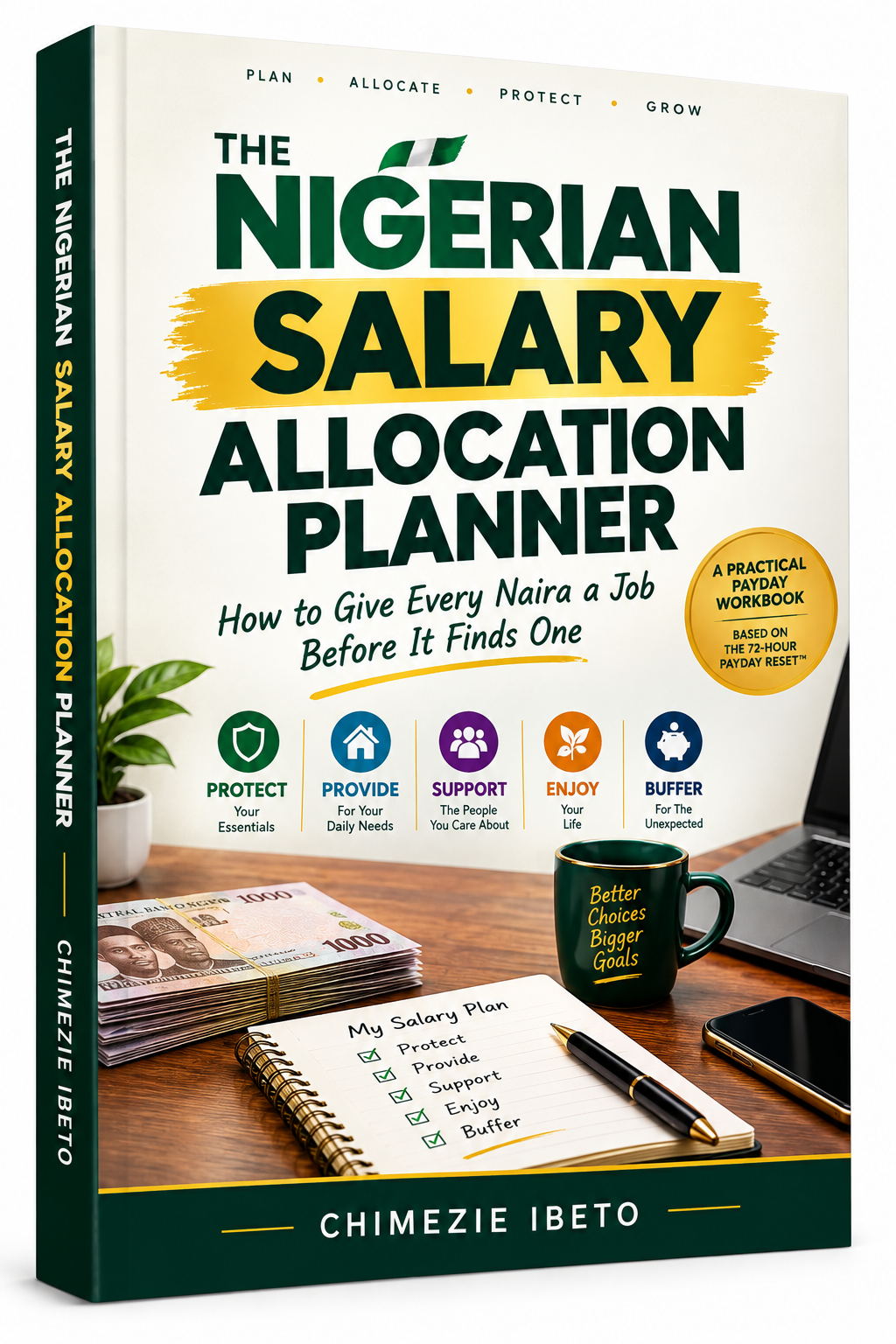
The Nigerian Salary Allocation Planner
Value: ₦6,500 — FREE today
A simple, ready-to-use worksheet that helps you divide your salary into the five allocations immediately after payday. No calculations to figure out on your own — the planner walks you through every step and gives you a clear, completed plan before the first naira leaves your account.

Bonus #2
The 30-Day Money Leak Tracker
Value: ₦5,500 — FREE today
A simple spending tracker designed specifically for Nigerian salary earners to find and eliminate the small-small daily spending leaks that quietly drain hundreds or thousands of naira every week — the ones too small to notice individually, but devastating when you add them up at month's end.
Everything You Are Getting Today
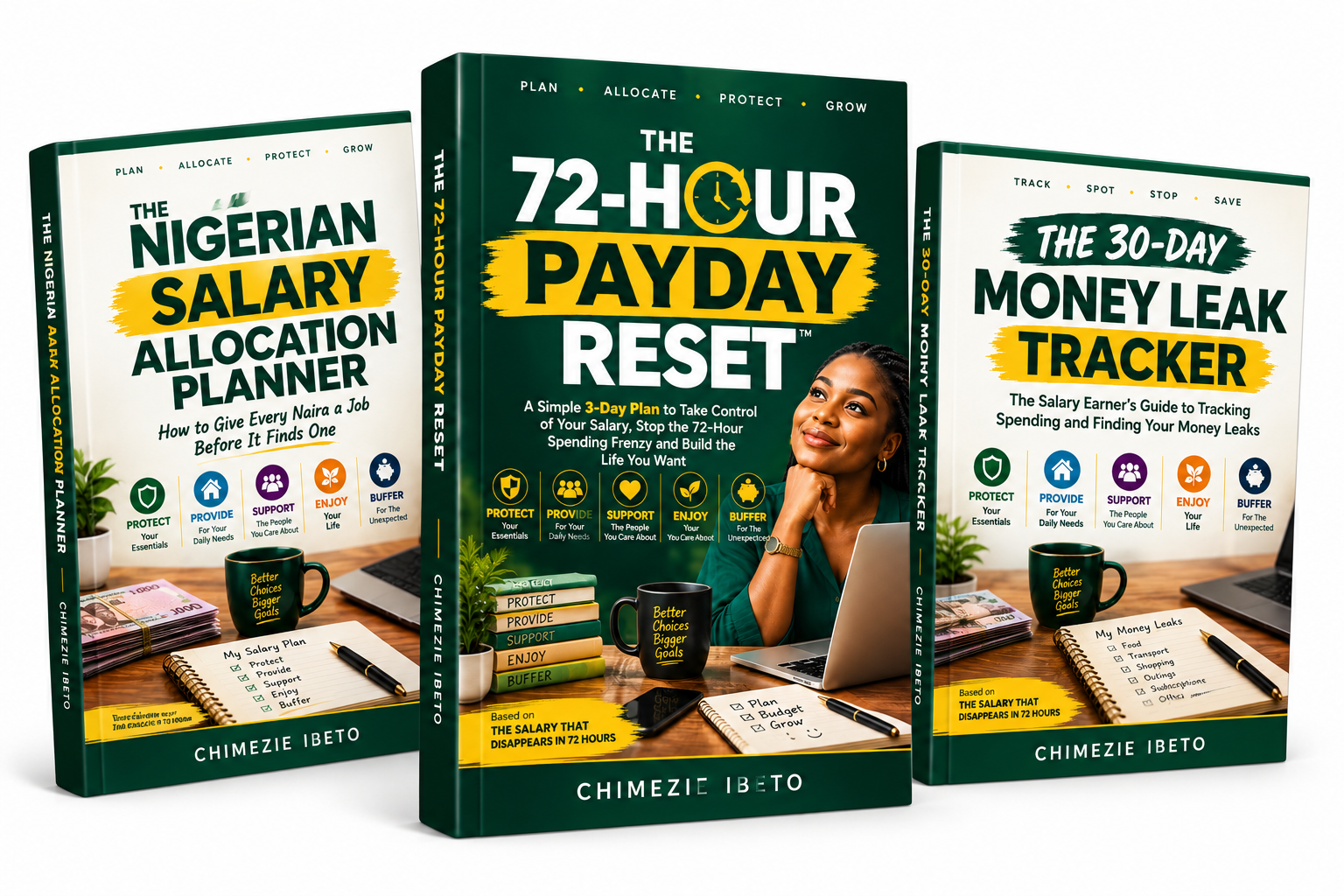
- The 72-Hour Payday Reset™ (Main Guide)
₦15,000 - Bonus #1: The Nigerian Salary Allocation Planner
₦6,500 - Bonus #2: The 30-Day Money Leak Tracker
₦5,500
Total Value: ₦27,000
You Pay Today: ₦7,500
Yes — Give Me Everything Now
Comments (312)
R
I read this whole post and cried. Not in a dramatic way — just the quiet recognition of someone who has lived every single thing described here. I have been watching my salary disappear before the end of the first week for seven years. Seven years of trying everything. I just purchased The 72-Hour Payday Reset. Whatever happens I am ready to try something that actually makes sense.
S
I have been using this structure for 6 weeks. I am a teacher, my salary is modest. But the guide works on any size salary — it adjusts to what you earn. I shared it with my colleague who is also a teacher. We both have money this month. Two teachers with money in the middle of the month. Something we would have called impossible three months ago.
C
The Support allocation section alone is worth the price. I have been unable to say no to family because I never had a structured answer. Now I have an actual amount that I set aside specifically for supporting others. When it is gone it is gone. Nobody can argue with a structure. They can argue with a person but not with a plan. My stress around family requests has reduced by 80%.
I
My wife shared this with me. I was reluctant — I have bought financial courses before that did nothing. But this is not a course. It is a system. Twenty minutes on salary day and the month is structured. No daily tracking. No daily decision fatigue. I am a busy man and I need something that runs itself. This does.
P
I am a single mother. I have two children and my salary is the only income in my house. I thought no budget structure could work for my reality because my expenses are too unpredictable. The Buffer allocation proved me wrong. It exists specifically for unpredictability. And the Protect allocation means my rent and utilities are settled before anything else touches the money. This guide understands Nigerian life.
T
My brother is a banker. I showed him this post and he said "this is basically what we teach high-net-worth clients but simplified for regular salary earners." He asked me where I found it. I said a blog. He said this should be taught in schools. I agree. Every salary earner in Nigeria needs this.
Share Your Experience
Right Now, You Have Two Choices
Choice 1: Close this page
- Next payday, same cycle begins again
- Money is gone before the week ends
- Family obligations consume everything
- Month ends in debt, borrowing, stress
- Another month passes with nothing saved
Choice 2: Get the guide today
- You implement the 72-hour reset on payday
- Money is structured before the world can take it
- You give confidently within a limit you set
- You reach month-end with money remaining
- You begin, finally, to build something real
The 72-Hour Payday Reset™ + Both Bonuses
₦15,000
₦7,500
One-time payment. Instant delivery to WhatsApp and email. First 50 people only at this price.
Yes — I Am Ready To Take Control Of My Salary
🛡 30-Day Money-Back Guarantee
Implement the 72-Hour Payday Reset™ exactly as described in the guide for 30 days. If you follow the protocol and your money situation does not improve — if you do not feel more in control, more clear, more structured — contact me and I will refund you in full. No lengthy questions. No hoops to jump through. My confidence in this system is my guarantee.
Get The Guide Risk-Free🛡 30-Day Refund
⚡ Instant Delivery
🔒 Private & Discreet
✓ Secure Payment
One Last Thing...
Picture yourself one month from today.
Your salary entered this week. You spent twenty minutes on the 72-Hour Reset. Every naira has a home. The rent is covered. The family obligations are handled within a limit you set. You have your daily money. You have your Enjoy allocation — guilt-free money that is yours to spend without anxiety.
Will you feel that weight gone — the constant mental calculation that follows you everywhere?
Will you have a conversation about money with your partner that is calm instead of tense?
Will you be able to say no to a financial request — confidently, kindly, without shame — because your structure has already made the decision for you?
Will you reach day twenty with money still in your account and feel something you may not have felt in years?
Now picture yourself one month from today if you close this page. Everything stays the same. The cycle runs its course again. Another month passes. Another payday disappears in 72 hours.
"The difference between those two versions of you is a decision you make in the next sixty seconds."
I Choose Control — Give Me The Guide Now
If you have read this far and you are still hesitating —
Ask yourself honestly: what are you waiting for?
Another payday to fail? Another month of the same cycle? Another version of the same promise to yourself that this time will be different — with nothing different actually in place?
The hesitation is not about the ₦7,500. You have spent more than ₦7,500 on things that did not help you. Airtime. Subscriptions. That weekend outing you barely remember. The money is not the barrier.
The barrier is the belief, somewhere underneath, that you have tried before and it did not work — so why would this be different?
This is different because it addresses the actual problem. Not your discipline. Not your willpower. The structure. The 72-hour window. The system that runs even when life is noisy.
If you cannot invest ₦7,500 in a structure that stops your salary from disappearing — one that pays for itself within the first month — how do you expect your financial life to invest in you?
Stop hesitating. Choose yourself. The guide is waiting.
Yes — I Am Choosing Myself TodayP.S. Remember — this comes with a full 30-day money-back guarantee. Implement the system for 30 days. If it does not work for you, I refund you completely. You are taking zero risk.
P.P.S. The ₦7,500 price is only for the first 50 people. This is not a marketing trick — once those slots are filled, the price returns to ₦15,000. If you can see this offer, spots are still available. Do not wait until they are not.
P.P.P.S. Every day you wait is another payday that enters and disappears before you can hold it. The cycle does not fix itself. The structure does not appear on its own. You have to put it in place. Today is as good a day as any — and better than most, because the offer is still here.
With respect for your financial journey,
Chimezie Ibeto
Frequently Asked Questions
How will the guide be delivered to me?
Immediately after your payment is confirmed, the guide is delivered to your WhatsApp number and email address within 60–90 seconds. You do not need to wait or follow up. You can begin reading and implementing on the same day.
Does this work for small salaries?
Yes. The 72-Hour Payday Reset™ is built around percentages, not fixed amounts, which means it scales to fit any salary size. The guide includes specific guidance for lower-income earners, addressing the real Nigerian reality of stretched salaries and heavy obligations. The structure works with what you actually earn — not an ideal number.
What if I have too many obligations? My situation is very complicated.
The guide specifically addresses the Nigerian complexity of family obligations, extended support networks, irregular expenses, and the unpredictable emergencies that make standard budgeting templates useless. The Support allocation and Buffer allocation exist exactly for this reason. The system is built for complicated real life — not a simple life that most Nigerians do not have.
My partner is not interested in budgeting. Will this still work for me?
Yes. The guide can be implemented by one person independently. It does not require your partner's participation — though many users have found that once their partner sees the results after the first month, they naturally become interested. Several couples have used it together with strong results, but it is not a requirement.
Is the money-back guarantee real?
It is completely real. Follow the protocol for 30 days. If your financial situation does not improve — if you do not feel more in control and more structured by the end of 30 days — contact me directly and I will refund your money in full. The guarantee exists because I have complete confidence in the system. I have seen it work across different salary levels, states, and situations. I am not worried about refunds.
How is this different from every other budgeting advice I have seen?
Most budgeting advice is reactive — it tells you to track where your money goes after it has already gone. The 72-Hour Payday Reset™ is proactive — it tells you to decide where your money goes before the world can touch it. The 72-hour window is the difference. Most people let that window close without doing anything intentional. This guide teaches you to use it deliberately, every single month, in twenty minutes or less. No daily tracking. No apps. No willpower required. Just structure.
Chimezie I have been following this structure for two months now. The first month I thought it was a fluke. Second month confirmed it. I sent ₦20,000 to my family, paid all my bills, bought myself a dress without guilt, and STILL had money left on the 28th. Two months ago I would have been begging to borrow small. This thing works if you do exactly what it says. The Support allocation alone changed my relationship with my family — I now know what I can give and what I cannot, and I say it without shame.